
Cleaning Services hours: Mon to Sat, 8 am to 7 pm

Cleaning Services from $40

5.0 out of 5.Rated 5.0 on Google

5.0 out of 5.Rated 5.0 on Google

Cleaning services

Post-Construction Cleaning Services in St. John’s

Post-construction cleaning in St. John’s clears what a renovation leaves, and that depends on what the work opened up. Old plaster and lath, drywall or a new build’s sanding dust each settle wherever the house lets them. Cleaning with HomeBrill starts at $40.

  • Starting at $40
  • Mon to Sat, 8 am to 7 pm
  • Call or text, no account needed

Book post-construction cleanup

No account needed. HomeBrill calls or texts you back to set a time for the visit.

Cleaning starts at $40. When HomeBrill calls or texts you back, ask about the price of your job before a time is set. Privacy: see the privacy policy. This site is protected by reCAPTCHA and the Google Privacy Policy and Terms of Service apply.

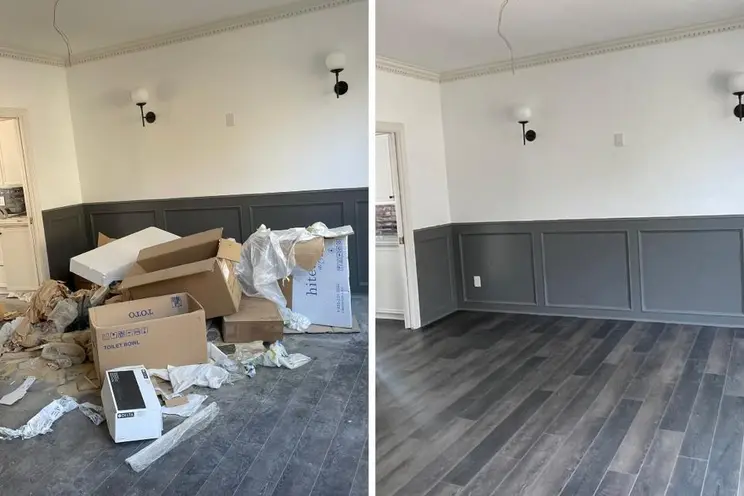
Post-construction cleanup in St. John's: a newly finished room before, with fixture boxes and packaging on the plank floor, and after, cleared Post-construction cleanup in St. John's: a newly finished room before, with fixture boxes and packaging on the plank floor, and after, cleared

What renovating a St. John’s house leaves behind

In St. John’s, the age of the house decides much of what a cleanup meets.

Opening the walls of an older house releases plaster rather than drywall, a heavier and grittier dust. Wooden lath, old nails and flakes from many coats of paint are mixed in. The paint is the part to ask about first. Health Canada advises treating paint in a house from before 1960 as likely to contain lead. If old paint was scraped or sanded and nobody tested it, ask the contractor before any cleaning starts. Lead dust is lifted with a HEPA vacuum and repeated wet wiping, never with a broom or an ordinary vacuum.

Asbestos is the other question, for any house built before about 1990, the oldest included: some plasters, textured ceilings, joint compounds and floor tiles of those years contain it. The list further down this page sets it out with the other residues a build leaves; dust from a material that might contain it is a specialist’s, not a cleaner’s. A new house has the simplest dust and the most of it. Sanding residue lies in every room, with sawdust in the cabinets, haze on the tile and glue from the labels, and plenty drawn into the vents before anyone moves in.

What a post-construction clean costs

Past HomeBrill’s $40 cleaning start, a cleanup after a renovation is priced on how far the dust travelled rather than how big the project was. A small job sanded in an open-plan house can coat every room. A larger one sealed off behind plastic may leave dust in two. The number of passes counts, and so do high ceilings, stairwells, paint on many panes of glass and haze across a large tiled floor. A furnished house takes longer than an empty one. If offcuts or packaging will still be there, say so, since hauling debris away is usually arranged apart from the cleaning. Describe the work and the rooms it reached, call or text Monday to Saturday between 8:00 am and 7:00 pm, and ask for the price before a time is set.

Before the dusty work starts

The smallest cleanup is the one that never has to happen, and much of the dust can be kept inside the work area. Plastic sheeting over the doorways, with a zipper door for the trades, stops it drifting through the house. Tape over the heating registers in the work area and switch the furnace fan off while drywall is sanded. A stairwell acts like a chimney for fine dust, so seal it if the work is downstairs.

Cover what stays in the room with plastic rather than cloth, since the finest dust passes through fabric. Empty nearby closets and shelves, and put electronics away, because dust inside a computer or a television is hard to get out. Many contractors set this up as a matter of course; ask what they plan before the work begins.

Where dust hides in an older house

Fine dust settles wherever air goes still, and an older house has more of those places than a new one. After a renovation in one of the city’s older homes, look at:

  • deep window sills and the tops of tall door casings, picture rails and plate rails;
  • the gaps between old softwood floorboards and under loose thresholds, where a mop only packs the dust in and a crevice tool lifts it;
  • floor registers and the ducts just below them, often the first place sanding dust lands;
  • old glass light globes and the inside of ceiling fixtures, cleaned with the power off at the switch and the bulb cool;
  • the treads and spindles of a staircase near the work, since a stairwell carries dust up and down the house.

Carpet that sat through the work holds dust deep in the pile, and carpet cleaning in St. John’s covers lifting it. The building work itself, from basements to kitchens, is on the home renovations page, and the cleaning services page lists what usually follows a cleanup, from carpets to windows.

See also Airbnb cleaning in St. John’s.

Problems and methods

What a renovation leaves behind

Post-construction cleanup deals with what a renovation leaves once the trades pack up. Fine dust lies on every ledge and inside every cabinet, with paint and caulk on glass and haze on new tile. Label glue sticks to new fixtures, and grit sits in vents and window tracks.

Construction dust is not ordinary household dust. It is much finer, it hangs in the air, and it keeps settling for days after the sanding stops. That is why a room wiped once looks dusty again the next morning. It also reaches places the work never touched: closed cabinets, the far bedroom, the inside of light globes.

The cleanup usually comes in stages. A rough clean once the heavy work ends lifts the bulk of the dust. A final clean before anyone moves back in covers every surface, inside cabinets, fixtures, glass and floors. A short touch-up follows if a trade comes back to finish something. The residues a build usually leaves, and what lifts each one, are in the lists that follow.

Renovated homes in the city take up the first part of this page. The work that comes before the cleanup, from basements and bathrooms to new drywall, is on the home renovations page. What usually comes after it is among the cleaning services.

What you see, and what removes it

Fine white dust that is back the morning after a wipe
Drywall dust still settling out of the air. A HEPA vacuum and damp microfibre, from the top of the room down, and more than one pass.
Paint specks and caulk smears on window glass
A razor scraper held flat on wet, plain glass; coated, tinted or tempered glass checked against the window maker’s advice first.
A cloudy haze over newly grouted tile
Grout residue left after the tiles were wiped. A haze remover made for that tile; acid-based ones are never used on natural stone.
Stickers and label glue on new windows, tubs and fixtures
Peeled off, then an adhesive remover suited to the surface; no blades on acrylic tubs, plastic or painted finishes.
Dust packed into registers and return grilles
Construction dust drawn into the ductwork. Grilles vacuumed and washed, and the furnace and ventilation filters changed or cleaned.
A grey film on new hardwood or vinyl plank
Fine dust ground in by boots. Vacuumed or dry mopped first, then a barely damp mop with the floor maker’s cleaner, never a soaking.
Dust inside new cabinets and drawers
It drifts in through every gap. Vacuumed and damp wiped, runners and hinges included, before anything is put away.
Grey dust from cut concrete or tile
It can carry crystalline silica. Never dry swept: a HEPA vacuum and wet wiping, with a respirator while it is disturbed.

Methods and materials

  • HEPA vacuum Captures drywall and concrete dust that passes straight through an ordinary vacuum’s filter and wears out its motor.
  • Damp microfibre Traps fine dust rather than spreading it; rinsed out often.
  • Razor scraper For paint and caulk on plain glass, held flat on a wet surface.
  • Grout haze remover Matched to the tile it is used on.
  • Adhesive remover For label glue and tape residue, tried on the finish first.
  • Replacement filters Furnace and heat recovery ventilator filters, which clog with construction dust long before their usual change date.
  • Respirator A well-fitted mask rated for fine dust, for anyone disturbing silica or drywall dust.

Pricing

What moves the price after construction

HomeBrill’s cleaning starts at $40. After construction, the size of the area and how dusty the work was decide most of a cleanup’s price. A sanded and painted basement leaves far more than a new vanity. A rough clean and a final clean mean we clean twice, in two visits rather than one. Paint and caulk on many windows, haze across a large tiled floor, stairwells and high ceilings all add time. Debris and offcuts are usually dealt with apart from the cleaning, so say whether any will be left. Explain what was built or changed, which rooms it touched and when the last trade leaves, and ask for the price in the same call. Calls can be made Monday to Saturday from eight in the morning until seven in the evening.

Cleaning starts at
$40
Your job
Describe it when you call or text, and ask about its price before a time is set

post-construction cleanup

Dust, debris and older houses

The finest dust is the one to respect. Cutting or grinding concrete, tile, stone and mortar releases crystalline silica, so dust from those jobs is never dry swept or blown around with compressed air. It is vacuumed with a HEPA filter or wiped up wet, and whoever disturbs it wears a well-fitted respirator. Drywall dust is less harmful but still irritates eyes and lungs, and it soon chokes the filter of an ordinary household vacuum.

Older houses add a question to ask first. In homes built before about 1990, some joint compounds, textured ceilings and vinyl floor tiles may contain asbestos. If the renovation opened walls or ceilings and nobody tested the old materials, ask the contractor before the cleanup starts. Removal is specialist work, and a cleaner should not be stirring that dust.

The rest is plain caution. Nails, screws and sharp offcuts hide in dust on floors and sills, so gloves and sturdy shoes come first. Windows open and the exhaust fans run while adhesive and haze removers are in use. If trades are still on site, the cleanup works around them, or waits, rather than cleaning a room that is about to be dusty again.

Downtown is the historic centre of St. John’s. Georgestown is an older inner neighbourhood uphill from downtown. Damp weather keeps windows shut, so fine dust from a renovation settles indoors. Photos of the finished rooms can go by text to (709) 910-9100.

After the cleanup

A few jobs follow the main clean. Carpet that lived through a renovation holds dust deep in its pile, and carpet cleaning is the step that lifts it. A newly finished wood floor needs its finish to cure before it is mopped, so ask the installer how long to wait. And window tracks and screens, which collect grit through the whole job, are covered on the window washing page.

FAQ

Questions about cleaning up after a renovation

Can renovation grit scratch a hardwood floor during the cleanup?

Yes. Plaster, tile and concrete grit act like sandpaper under a shoe or a dragged mop. The floor is vacuumed first with a soft brush head, before anything wet touches it, and the mop or pad is rinsed often. Mats inside the doors to the work area, shaken outside each day, keep the grit from travelling while the trades are still in.

Why does a room smell of burning when the heat comes back on after a renovation?

Usually it is dust on the heater. Fine dust settles on the fins of electric baseboard heaters and inside a furnace, and it scorches the first time they warm up. Turn baseboard heaters down and let them cool, vacuum the fins with a brush attachment, and change the furnace filter before the heat runs. A smell that lasts beyond the first warm-up, or any smoke, means switching the heater off and having it looked at.

Why does wiping drywall dust off a wall leave streaks?

Because wet gypsum dust turns to paste. It smears into a thin film that dries as a white haze, most of all on flat or matte paint. Take the dust off dry first, with a HEPA vacuum’s brush or a dry microfibre cloth, then wipe with a cloth that is barely damp and rinsed often. On walls painted in the last few weeks, keep to dry dusting.

What is worth checking after a post-renovation clean?

Run a hand along the tops of door frames and window casings, and look inside a couple of drawers and cabinets. Lift one floor register, and check light globes and window glass in low sun. A light film that settles over the next few days is the dust still coming out of the air; dust left where nothing was touched is something to point out.

At what point in a renovation should the cleanup be booked?

Once the last trade has finished the work that makes dust, and before furniture and people move back in. On a long job a rough clean between stages can help, but the final clean waits until nothing else will be sanded, cut or painted. Leave a day of slack after the last trade’s visit in case the work runs over.

Do the ducts need cleaning after a renovation?

Not always. Where the registers were covered and the system was off or filtered while the dusty work went on, cleaning the grilles and changing the filters is usually enough. Where the furnace ran through weeks of sanding with the registers open, dust can coat the ducts themselves. Cleaning them is a trade of its own with its own equipment. Run the system for a day after the clean and check whether the new filter greys within days.

Why should labels and protective film come off new fixtures soon?

Because the adhesive gets harder to remove the longer it stays on, especially where sun reaches it. Film left on a window frame or an appliance through a summer can bake onto the surface. Peel labels and film within the first weeks, and lift what is left with an adhesive remover tried first on a hidden spot.

How soon can new grout be cleaned with everyday products?

Not until it has cured, for the days the grout’s maker sets out on the bag. Until then, clean new tile with plain water or a pH-neutral cleaner, since acidic or harsh products can etch or discolour fresh grout. If the grout is to be sealed, that comes once it has cured and before regular cleaning begins.

Book post-construction cleanup in St. John’s

Call, text or send the form, Mon to Sat, 8:00 am to 7:00 pm.