
Handyman Services hours: Mon to Sat, 8 am to 7 pm

Handyman Services from $50

5.0 out of 5.Rated 5.0 on Google

5.0 out of 5.Rated 5.0 on Google

Handyman services

TV Mounting in St. John’s

TV mounting in St. John’s depends on the wall behind the screen: plaster on lath, drywall over studs or strapping on a concrete basement wall. Each takes different fasteners, and the size of the set and the layout of the room settle the rest. Handyman work with HomeBrill starts at $50.

  • Starting at $50
  • Mon to Sat, 8 am to 7 pm
  • Call or text, no account needed

Book TV wall mounting

No account needed. HomeBrill calls or texts you back to set a time for the visit.

Handyman services start at $50. When HomeBrill calls or texts you back, ask about the price of your job before a time is set. Privacy: see the privacy policy. This site is protected by reCAPTCHA and the Google Privacy Policy and Terms of Service apply.

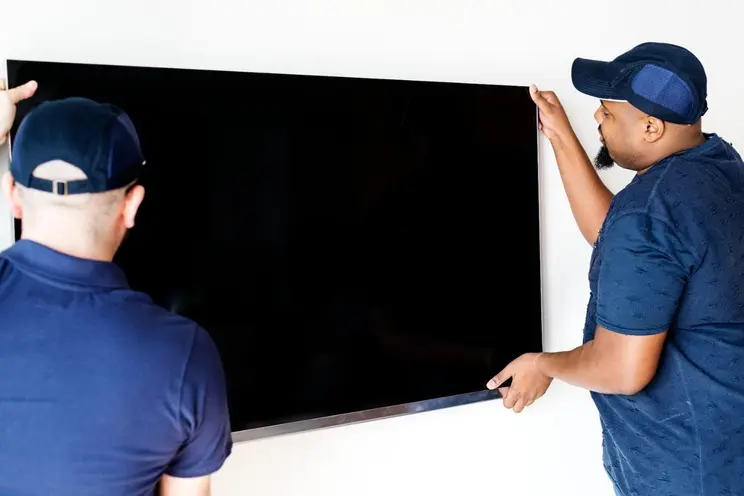
TV wall mounting in St. John's: two men lifting a flat-screen TV onto a wall TV wall mounting in St. John's: two men lifting a flat-screen TV onto a wall

Three walls you might find behind the screen

Three kinds of wall turn up behind a TV, and each one changes how a mount is fixed.

In older houses, many walls are still plaster on wood lath. The surface is hard and the layer behind it brittle. Holes are drilled slowly with a sharp bit and no hammer action, and the mount’s bolts go through the lath into the studs it is nailed to. If a test hole in the chosen spot crumbles or finds nothing solid, moving the TV is wiser than trusting the plaster.

In a house framed in recent decades, interior walls are usually drywall on wood studs. That is the plain case: find two studs, mark their centres and drive the lag bolts into solid wood. The snag is that studs seldom fall exactly where the room wants the screen. A mount with a wide wall plate, or one whose bracket slides along the plate, lets the TV sit a little to one side of its fasteners.

The finished basement is the third case, and the one most often misjudged. Its drywall may hide a framed wall standing in front of the foundation, or thin wood strapping fastened straight onto the concrete, and a stud finder reports both as studs. Strapping is too thin to hold lag bolts under a TV’s load. On a strapped wall the fasteners pass through it into the concrete, with masonry anchors set in holes drilled by a hammer drill. A small test hole, or a look at an unfinished corner or the utility room, shows which wall you have.

Fitting the screen to the room

In an open plan where the TV has to be seen from the sofa and from the kitchen, a full-motion arm swings it between the two. That arm needs two studs or solid masonry. Mount types, viewing height, the fireplace question and which cables may run inside a wall are all covered further down this page.

Plan the soundbar, the cable box and the game console at the same time as the screen. Where they sit decides where the cables run, and a shelf under the screen is far easier to line up before the TV goes up than after. Shelves and the walls they hang on are covered by shelf and mirror mounting in St. John’s.

Taking a TV down: moving out, renting, replacing

A mount comes off the wall more often than people expect: at the end of a lease, before a move, or when a bigger set arrives. Unplug everything first. Then one person holds the TV while the other releases it. Most mounts have a locking screw or a safety strap at the bottom of the arms that has to come out before the set lifts off.

The wall keeps the evidence: lag bolt holes, anchor holes, sometimes a torn patch of drywall paper where a toggle pulled through. Those are filled, sanded and primed as drywall repair, a step any tenant handing the wall back should allow for.

What to send before a TV goes up

HomeBrill’s handyman services start at $50. What your mounting costs depends on the set, the mount, the wall and the cables, so ask for the price of that job before a time is set. The handyman line, (709) 910-9100, answers calls and texts from eight in the morning until seven at night on weekdays and Saturdays. Or use the booking form at the top of this page.

Send the TV’s make and model number, from which its weight and hole pattern can be looked up, and the mount if you have already bought one. Add which floor the room is on, and a photo of the wall with the nearest outlet in view. Every other job on the handyman list is on the handyman services page.

Problems and materials

What decides how a TV goes on the wall

TV wall mounting puts flat screens on drywall, plaster, brick or concrete. The mount matches the set and is fastened where the wall can carry it, with a plan for the cables.

Three things settle a TV mounting before any drill comes out: the set, the mount and the wall behind them.

The mount has to fit the set first, which the questions below explain how to check. Then choose the mount for the room. A fixed plate keeps the screen tight to the wall. A tilting mount suits a screen above eye level. A full-motion arm swings the set toward a corner or the kitchen, and of the three it asks the most of the wall behind it.

The wall is the part you cannot see. Most interior walls are drywall over wood studs, and lag bolts hold only in the middle of a stud. Older houses may have plaster on wood lath, which cracks if drilled carelessly. Basement and feature walls may be brick or concrete. Some condos are framed in steel studs, which limit what an arm can carry. The list below shows what goes wrong when the three are mismatched, and the top of this page covers the walls of the city’s homes.

Houses in St. John’s range from 19th and early 20th century wooden row houses in the downtown to post-war suburbs and newer subdivisions along the west and north edges. Downtown homes are mostly attached wooden row houses on steep streets rising from the harbour. Older attached and row houses fill most of Georgestown’s streets. In an attached house, check whether the wall you want is the one shared with the neighbour before anything is drilled.

What you notice, and the usual causes

The screen leans forward on a full-motion arm
Lag bolts that caught only the edge of a stud, a wall plate that has worked loose, or a set heavier than the arm is rated for.
A sore neck after an evening on the sofa
The screen hung well above seated eye level, often over a fireplace, on a fixed plate with no tilt.
Cables dangle below the screen
No route planned for power and HDMI before the mount went up.
Plaster cracked or brick spalled around the bolts
Plaster drilled without a pilot hole, or anchors set in the mortar between bricks instead of the brick itself.
Holes left behind after an old mount came down
Lag bolt and anchor holes, a small patching job before the wall is painted.

Materials and hardware involved

  • Fixed mount Holds the screen flat and close to the wall, with the least leverage on the fasteners.
  • Tilting mount Angles the screen down toward the viewer when it hangs above eye level.
  • Full-motion arm Pulls out and swivels to aim the screen at another part of the room.
  • VESA hole pattern The standard spacing, in millimetres, of the threaded holes on the back of a TV.
  • Lag bolts and masonry anchors Heavy screws into the centre of wood studs, or anchors set in brick or concrete with a hammer drill.
  • In-wall rated cables HDMI and other low-voltage cables marked as made for use inside a wall.
  • In-wall power kit A listed kit that joins a recessed outlet behind the screen to an inlet near the outlet below, so the TV’s own cord stays outside the wall.
  • Surface raceway A paintable channel on the wall face that covers cables without opening the wall.

Pricing

What moves the price of a TV mounting

The handyman service starts at $50. Past that start, the price follows the wall and what goes on it. A fixed plate on drywall over studs is the plain case. Brick and concrete take longer, because every hole is drilled with a hammer drill. A full-motion arm needs its two studs found exactly where the arm should sit. A fireplace wall raises questions about heat and the masonry behind the mantel, and hiding cables or adding a soundbar adds to the job.

When you call or text, give the screen size and weight, and the mount if you already have one. Add the wall material if you know it, and where the cables should end up. A photo of the wall with the outlet in view answers a lot. Then ask what the job will cost before a time is set. Handyman hours run Monday to Saturday, from 8:00 am to 7:00 pm.

TV mounting is booked Monday to Saturday, 8:00 am to 7:00 pm. Text the model of the set and the mount, with a photo of the wall, to (709) 910-9100.

Handyman services start at
$50
Your job
Describe it when you call or text, and ask about its price before a time is set

TV wall mounting

Hiding the cables, and where an electrician comes in

Low-voltage cables (HDMI, an optical audio lead, the antenna or cable line) may run inside a wall if they are rated for in-wall use. The rating is printed on the jacket. The TV’s power cord is another matter. A cord is made to lie in the open, not to be shut in a wall cavity where it can be crushed or overheat unseen. It must not be fished through the wall.

Power has two proper routes. One is a listed in-wall power kit, which puts a recessed outlet behind the screen and joins it through the wall to an inlet near the outlet below. The TV’s cord never enters the wall. The other is a new outlet behind the set, and a new outlet is new wiring, work for a licensed electrician. Electrical work in Newfoundland and Labrador is regulated by the province, with permits and inspections.

Where the wall cannot be opened, a surface raceway hides the cables in a paintable channel. Outside walls are the hardest to run cables through. Behind the drywall sit insulation and, in most newer houses, a plastic vapour barrier, and a hole in that barrier lets damp indoor air into the wall.

Over a fireplace, and a TV on a stand

Above a fireplace, the heat and the viewing angle are the questions to settle first, as the answers below describe. What sits behind the mantel then decides the fasteners: a brick or stone chimney takes masonry anchors, while a framed chase is studs and drywall like any other wall.

A TV that stays on a stand still needs fastening. Health Canada advises anchoring TVs and tall furniture to the wall so they cannot tip onto a child. An anti-tip strap from the set or the stand into a stud does it. Building the stand is furniture assembly, a shelf for the console beside the screen is shelving and storage mounting, and the bolt holes an old mount leaves are drywall repair. The handyman services page lists the other jobs.

Rabbittown is an older neighbourhood whose houses are small and closely spaced. In a small living room the viewing distance is short, which favours a smaller set or a lower mount. Tenants in rented rooms should ask the landlord before any mount goes up, and fill the holes when it comes down.

FAQ

Questions about screens, walls and moving house

Which wall suits a TV in a room with big windows?

Usually a wall at right angles to the windows. A screen facing them reflects daylight for much of the day, and a screen hung between two windows means watching against the light. If the wall opposite is the only choice, a slight downward tilt and a blind or curtain drawn in the afternoon cut most of the glare. Curtain and blinds installation in St. John’s covers the window side.

Can a TV mount move house with me?

The wall plate and the arms can, as long as they are rated for the set they will carry next. The fasteners are another matter: toggles and masonry anchors stay in the old wall or are ruined coming out, so the new wall gets new ones chosen for it. Tape a bag with the screws that fit the back of the TV to the mount, because those are the pieces that go missing.

How should a flat screen be carried once it is off the wall?

Upright, by two people, holding the frame rather than the panel. Many makers advise against laying a large flat screen on its face or its back, because the panel can flex and crack. The original box is the safest way to move it; otherwise wrap it in a blanket and stand it upright between soft things.

Can a soundbar hang under a wall-mounted TV?

Yes, on a bracket of its own or on an attachment made for the TV mount. If it hangs from the mount, the mount has to be rated for the TV and the soundbar together. Leave a gap between the bar and the bottom of the screen, since a soundbar set too close can block the remote control sensor.

Is a landlord’s permission needed before mounting a TV in a rental?

Check your lease and ask before anything is drilled. Some landlords allow a mount if it goes into studs, and some ask for the holes to be filled when you leave. Others would rather see the TV on a stand. Get the answer in writing.

At what height should a wall-mounted TV hang?

A common rule puts the middle of the screen close to the eye level of someone sitting on the sofa. Sit where you usually watch and have someone mark the wall at your eye height before the plate goes up. If the screen has to go higher, a tilting mount angles it back toward you.

Is the wall above a fireplace a good spot for a TV?

It can work, but check the heat guidance in the TV maker’s manual and the clearances in the fireplace’s own manual first. The other cost is the viewing angle, since a screen above a mantel sits well over eye level from the sofa. A tilting or pull-down mount eases that.

How can I tell whether a mount will fit my TV?

Look at the four threaded holes on the back of the set. Their spacing is the VESA pattern, given in millimetres in the TV’s manual, and the mount’s box lists the patterns it accepts. The mount also has to be rated for more than the TV weighs.

Book TV wall mounting in St. John’s

Call, text or send the form, Mon to Sat, 8:00 am to 7:00 pm.